 English
 Հայերեն
 Русский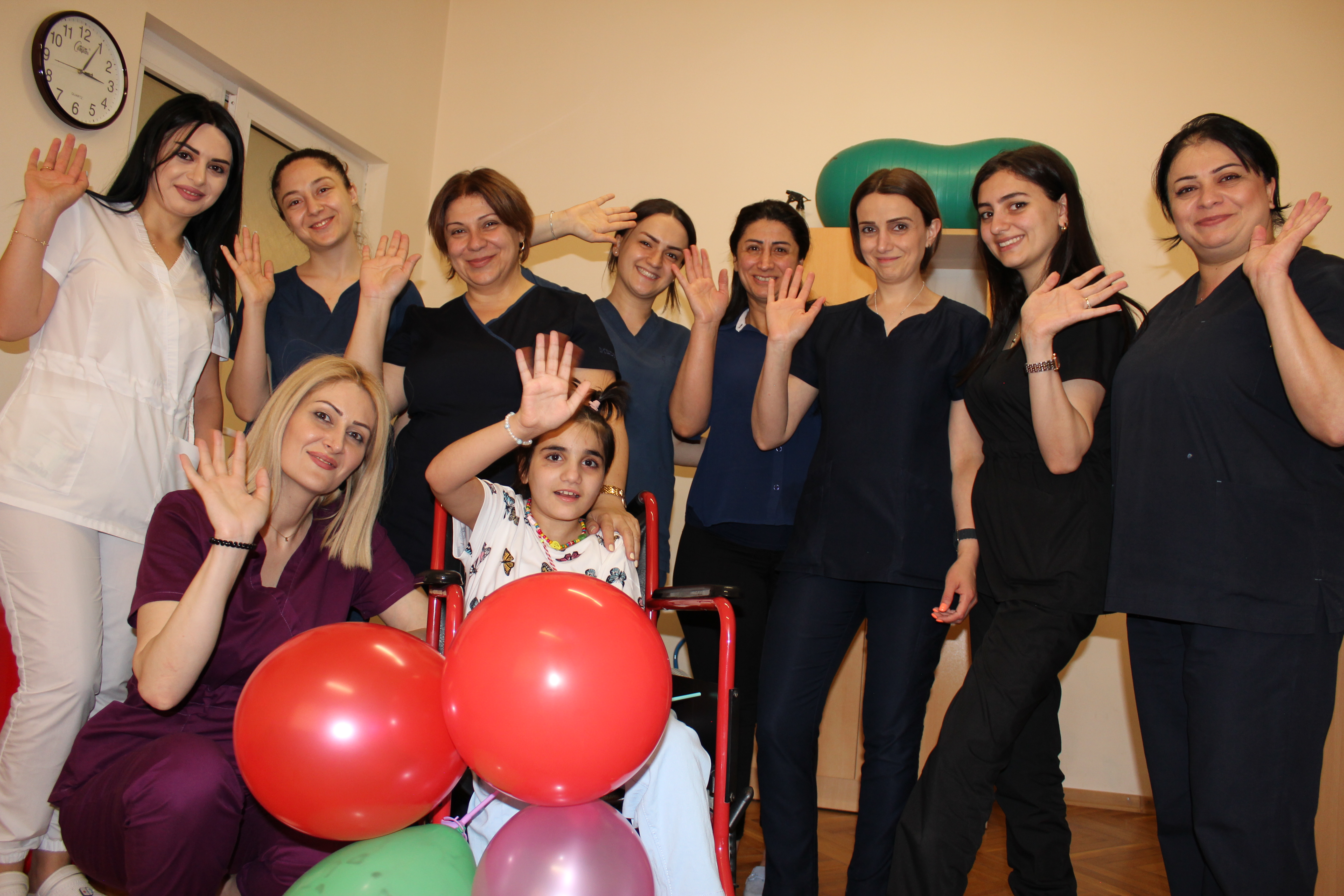
The stories of 15-year-old Mher and 10-year-old Arin are emotional and seem almost miraculous. Mher was involved in a car accident in Yerevan, while Arin experienced a car accident in Iraq. Both children were in critical condition and taken to intensive care units of medical institutions - one in Yerevan, the other in Iraq. Then operations were performed, and they were transferred to the rehabilitation service of the "Arabkir" medical center.
Now that the children have been discharged, their relatives admit that this road was undeniably challenging, but they were able to get through it with the help of dedicated professionals, cooperations between different medical institutions, coordination with the Ministry of Health and strong teamwork within the hospital.
Thank you, dear doctors and the team of rehabilitation service: physiotherapists, occupational therapists, speech therapists. Mher and Arin are really strong thanks to you.
Thank you, news.am.
In the clinical rehabilitation department of the "Arabkir" medical center, specialists are working to help 15-year-old Mher Avdalyan to get back on his feet. A specialized team of physiotherapists and occupational therapists works with him.
On February 20, Mher was hit by a car. He was taken to the hospital in critical condition. The boy suffered a cranial injury, multiple fractures, including his neck. He slipped into a coma for nine days, then regained consciousness, but had developed complicated pneumonia, and experienced difficulties with movement and communication.
Liana Aghajanyan /Pediatric Rehabilitation Specialist, manual therapist, head of the Clinical Rehabilitology Department at the“Arabkir” MC/ — Mher Avdalyan was brought to the hospital on a stretcher, with a tracheostomy. He had to be fed through a nasogastric tube since he was unable to consume his daily ration. There were difficulties with drinking, he was unable to sit, also his leg was broken and was in a cast. Rehabilitation was aimed at eliminating secondary complications, as in many cases patients can die because of it: wounds, vascular plaques, etc. As the patient had been in a horizontal position for an extended period, the process of sitting was particularly challenging. However, he managed to sit, achieve an independent sitting position, use his hands, get up independently, and stand.
Mher's mother holds strong faith and unwavering belief that they will overcome this stage as well, and the child will be able to walk. Along with specialists, Mher's family also helps him in his recovery.
Gohar Avdalyan /Mher’s mother/ — “Arabkir” medical center helped my child a lot to get back on his feet. I am very grateful to them for the care provided by the doctors and everything they have done. Well, I have never been here, I am a mother of six children, but none of them has been in a hospital before. They did a great job, thanks to which my child can now sit. Previously, he couldn't sit and was always lying down, but now he can sit and talk. He was not able to communicate at that time, but now he communicates and expresses his needs.
After completing the rehabilitation treatment in the acute phase, when boy’s condition had stabilized, and the boy was able to sit, drink and eat by himself, and his respiratory function had fully recovered and the tracheostomy was removed, Mher went to the next stage of rehabilitation treatment at the ArBeS Health Center of the “Arabkir” medical center. Although he still relies on a wheelchair, Dr. Liana Aghajanyan considers it a big achievement. They are hopeful that with ArBeS' training, Mher will regain the functions of standing and moving.
Dr. Liana Aghajanyan shares details about another complicated case. 10-year-old Arin Petrosyan was brought to "Arabkir" medical center following a serious car accident that took place in Iraq. After spending two months in the intensive care unit there, Arin had to be transferred to Armenia due to the unavailability of rehabilitation services. The Ministry of Health directed her to the “Arabkir” medical center, which houses a specialized clinical rehabilitation department.
Liana Aghajanyan — Why clinical rehabilitation? Because there are various medical conditions, where relying solely on inpatient care may not be safe, especially when there is no multidisciplinary team available to provide timely services.
After experiencing any trauma, particularly brain or spinal cord injuries, burns, amputations or severe orthopedic damage, children require reintegration into their normal lives. To achieve this, a series of measures must be taken to help the child to return to their everyday life.
Arin was brought to the medical center on a stretcher. She had multiple fractures, had a shunt, and was receiving anti-seizure treatment. Due to neurological damage, she was unable to hold her head, sit, or turn over in bed, and her speech was also absent. The fact that the child did not understand Armenian, made the doctors' work difficult.
Arin came from a large family of eight, but only she and her younger brother survived. In Armenia, her relatives took care of her.
Liana Aghajanyan — After rehabilitation, the child was able to sit independently, maintain a stable sitting position, although these actions were impossible in the first month. She started using her hands, but the neurological deficit was still present, and the actions were performed with errors. She began to understand and speak Armenian, even though the main language was Arabic. The center's speech therapist learned Arabic, while Arin learned Armenian, and their communication was significantly improved. The recovery progressed to the stage where the child was able to hold and stand. However, walking was still not developed due to some remaining leg contracture.
Rehabilitation therapy is a collaborative effort, coordinated by a rehabilitation physician, with each specialist contributing their expertise. The physiotherapist focuses on improving large movements such as sitting, standing, moving, walking and developing balance and coordination. With the help of the occupational therapist, self-care skills are restored, including eating, dressing, combing, washing, as well as performing delicate actions with small objects by enhancing the development of sensory receptors. The speech therapist’s work is aimed at enhancing speech perception and pronunciation, as well as correcting any disorders related to swallowing to ensure safe eating and drinking.
Liana Aghajanyan — Our entire therapy approach was based on the concept of play. It is essential in our work, as it creates motivation. Over the course of approximately 4 months of rehabilitation treatment, Arin's health condition has significantly improved.
Thus, slowly moving forward, the team bid a fond farewell to Arin, who had become everyone's favorite. She was now making jokes and even imitating Mher, who was practicing in the next room.
Arin imitating Mher — Lilia, Mher talks like this - ya, ya, ya…
Vigen, a family friend, uncle, as Arin called him, came with his children and conveyed the words of gratitude from Arin’s grandmother.
The “Arabkir” medical center’s Rehabilitation department serves many children, like Arin and Mher, and adults, including soldiers wounded during the war. With the support of a professional team, they regain their lost skills and reintegrate into the next stages of life.