 English
 Հայերեն
 Русский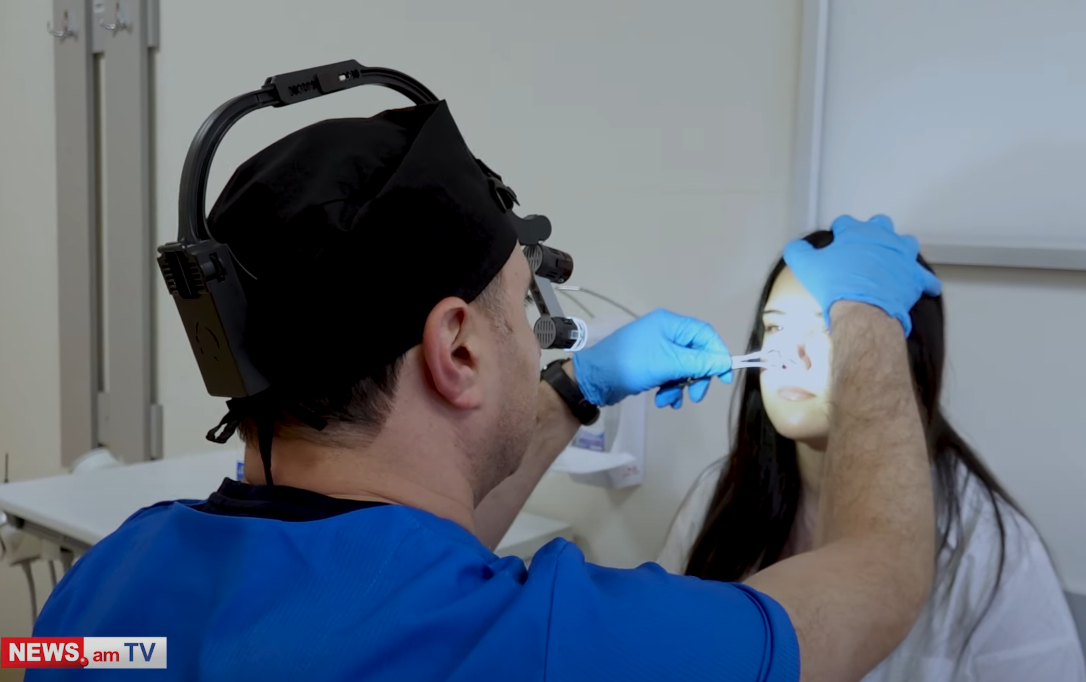
Respiratory disorders are quite common among both children and adults, arising from various reasons and requiring different professional approaches.
All the solutions for respiratory disorders are centralized in “Arabkir” medical center, spanning diagnosis, treatment, prevention and control. Through collaborative efforts across our multidisciplinary teams, patients not only receive treatment, but also regain the ability to breathe fully and continue living their lives.
The video of News.am is about respiratory disorders and modern ways for alleviating them.
-
Encountering challenges while breathing through your nose can result from a variety of reasons. Nasal congestion may stem from infectious diseases or anatomical deviations/neoplasms.
Gurgen Harutyunyan, the head of the pediatric and adult ENT service at the “Arabkir” MC, points out that the most common causes of shortness of breath in children and adults are different:
The most common concern in adults is deviated septum. Two primary factors contribute to this issue. Firstly, the cartilage component of the septum, which divides the nose into left and right segments, develops much quicker than the surrounding skull bones. Consequently, it does not fit in there leading to deformation. Second most common cause are nasal traumas, even those sustained during childhood but not manifesting at that time, but along with the growth and development, the septum is deformed again, hindering normal breathing. Additionally, nasal turbinates become hypertrophic, often resulting from septal curvature or prolonged use of vasoconstrictor nasal drops. This problem can coincide with polyps, which lead to obstruction of the nasal passages.
For children, the prominent cause often revolves around the proliferation of adenoid tissue, located in the nasopharynx. This tissue regresses at the age of 9-10, and the problem disappears. However, in many cases the tissue overgrows, impending normal breathing. Treatment hinges on the level of tissue overgrowth.
If polyps are present in the nose, computed tomography is mandatory to determine the precise location of the polyps and the scope of the operation. At "Arabkir" MC, this procedure is now conducted using endoscopic techniques:
Currently, the operation of polyps in the nasal and adjacent cavities is performed with modern endoscopes in our clinic. This method ensures minimal damage, no incision is made and the surgery is performed through the nostrils under monitoring.
In addition to the endoscope, the ENT service of the center is equipped with a spectrum of modern devices, which are used for nasal turbinate ablation.
Numerous patients are concerned about turbinate hypertrophy, while others have difficulty breathing related to the septum. There are modern approaches in turbinate related disorder treatment: surgical intervention, when vasotomy, lateralization is performed, as well as ambulatory operations on turbinates. In our clinic, we have the Selon device of Olympus company, which is a modern, conservative, sparing and quick method. Through ablation, the size of turbinates is reduced, hence we have a good effect.
Another significant contributor to respiratory complications is allergic rhinitis. And for the treatment of this group, it is necessary to see not only an ENT doctor, but an allergist as well. At the "Arabkir" Medical Center, we adopt a comprehensive approach to tackle this concern. Should your breathing difficulties be suspected to stem from allergies, your otolaryngologist will seamlessly refer you to our allergology service for thorough evaluation. Subsequently, the ENT specialist will administer treatment to alleviate the repercussions of the allergy-induced breathing problems.
According to Gurgen Harutyunyan, it is necessary to pay attention to polyps, as they can have allergic origin and correlate with bronchial asthma.
That is why in such cases we often turn to an allergist for medical advice and the diseases are managed in collaboration. In cases where asthma is identified, thorough preparation under the guidance of an allergist is important prior to polyp removal surgery. Pulmonary function tests are performed, the severity of asthma is assessed, treatment is prescribed, the patient is prepared and ready for the operation.
Allergic rhinitis is also common, leading to difficulty breathing, edema of turbinates and continuous production of mucus coupled with sneezing. Allergic rhinitis can be seasonal and perennial. The treatment here is performed not only by otolaryngologist prescribing drops, but with collaborative effort with allergists to discern the allergen type and recommend medications. When the problem is allergic rhinitis, constant sneezing, difficulty breathing and the patient is examined, we evaluate the color of mucous membrane and turbinates, the severity of swelling, the degree of reduction, the patient’s history (the frequency of patient being sick), then the diagnosis of allergic rhinitis is given followed by collaborative medication prescriptions with allergists. However, surgical intervention emerges as a necessity when a notable septal deviation accompanies allergic rhinitis. Therefore, even in case of reduced turbinates, the deviation will affect the breathing. Surgical correction becomes the preferred route in such instances. The septum deviation is straightened, and turbinates are reduced. A common query that arises is whether symptoms will fade after surgery. The patient’s allergic rhinitis will not be eliminated after the surgery, but when we straighten the septum and the air starts to flow properly, in case of an allergy, when turbinates are enlarged, the breathing will not be that affected and difficult.
As explained by Astghik Baghdasaryan, who leads the Respiratory Medicine and Allergology service, allergy diagnosis unfolds through a two-step procedure:
The initial step involves skin prick tests, which enable the assessment of hypersensitivity or sensitization to a wide array of commonly encountered allergens and facilitate the prescription of conservative treatment for allergic rhinitis. The treatment can be of two types: seasonal therapy and definitive treatment, known as allergen-specific immunotherapy. The latter requires molecular diagnostics, which we conduct as well. That is, when we want to determine which solutions are needed for target therapy, because different people have allergies to different agents or its parts.
To tailor treatment with precision, we employ molecular diagnosis through blood tests, recommending immunotherapy that extends over 3-5 years. Our objective is to sustain treatment for a minimum of 3 years, resulting in a remarkable reduction of allergic rhinitis symptoms by 60-80% throughout the individual's lifetime. Consequently, even if a patient struggles to breathe normally for 3-4 months each season, even with daily medication usage, the risk of lower respiratory tract inflammation and asthma diminishes. This gradual reduction in medication consumption by 60-80% annually significantly curtails the probability of asthma development.
“Arabkir” medical center has a unique respiratory laboratory for allergy and asthma examinations, where static and dynamic lung volumes are measured, various biomarkers are checked, lung and heart functions are checked during physical exertion:
Since allergies are often accompanied by asthma, we have a unique respiratory laboratory in Armenia, which allows us to measure static and dynamic lung volumes. These encompass crucial parameters such as lung capacity, the rate of exhalation, residual air volume post-breath, and the objectivity of these indicators.
We use body plethysmography for children, with whom we work often and they have difficulties with the proper technique of the examination, or for the elderly, who too, have difficulties related to chronic diseases. This examination allows us to measure lung capacities regardless of the patients’ will. Based on this objective data, we are able to confirm or reject the diagnosis.
We also have biomarker tests. That is, if we want to know whether there is a chronic inflammation in the patients’ airways and whether the treatment will be temporary or long-term, we determine the level of nitrogen oxide in expiratory air. It is an allergic inflammatory biomarker in the airways and is predominantly used in developed countries, serving as a crucial diagnostic tool for asthma confirmation.
We also have confirmatory tests for the diagnosis. As we work with draftees as well, for whom it is very important to know whether the person is having difficulties during physical exertion, and if so, what kind of problem it is: is it related to breathing, heart, or metabolism? In this case we have two types of tests. The first one is an exercise induced asthma test, when the patient is running and we are able to determine the changes of the airways. The second one allows us to check the heart, besides the airways. That means we conduct electrocardiography, and at the same time we determine the levels of inhaled and exhaled carbon dioxide, oxygen, and how the heart works. Also we are able to determine if the restriction of physical exertion is associated with improper function of the body or the lack of training. We often use this test to find out the physical preparedness of athletes.
According to Astghik Baghdasaryan the nose is like the “chimney” of the respiratory tract. When it is blocked, a problem can potentially occur in the lower airways because the upper and lower airways are always connected. From the “chimney" to the airways, then to the main organs - the lungs, and the other way: in “Arabkir” MC all areas of healthy breathing are in the center of attention, diagnosing, treating, protecting and preventing in all ways.